

According to the National Highway Traffic Safety Administration’s 2023 data, motorcyclists are 28 times more likely to die in a crash than passenger car occupants per mile traveled — yet many of the most effective prevention strategies remain underutilized or misunderstood by riders. As motorcycle technology advances rapidly and road conditions become increasingly complex, the gap between protective capability and actual protection continues to widen. For the 8.6 million registered motorcycles on American roads, understanding evidence-based risk reduction isn’t just about following basic safety rules — it’s about leveraging modern protective technology, behavioral strategies, and environmental awareness that can dramatically shift the odds in a rider’s favor.
The difference between a survivable incident and a tragedy often comes down to decisions made long before the motorcycle starts. From the engineering behind helmet design to the psychology of defensive riding, each factor contributes to a comprehensive approach that goes far beyond “wear bright colors and ride carefully.”
How Motorcycle Helmets and Gear Protect Riders
Modern motorcycle helmets function as sophisticated impact management systems, not just hard shells. The multi-density foam liner — typically expanded polystyrene (EPS) — is engineered to compress at specific rates during impact, extending the deceleration time from milliseconds to a full second. This temporal extension reduces peak force transmission to the brain by up to 85% compared to an unprotected head striking the same surface.
DOT and Snell certification standards require helmets to withstand impacts at specific velocities while maintaining structural integrity. The critical difference lies in retention systems: a properly fitted helmet with a correctly adjusted chin strap distributes impact forces across the skull rather than concentrating them at the point of contact. However, helmet effectiveness drops dramatically with age — the EPS liner degrades over time, and manufacturers recommend replacement every five years regardless of visible damage.
Beyond helmets, protective gear operates on impact distribution principles. Quality motorcycle jackets incorporate CE-rated armor at shoulders, elbows, and spine — dense foam that hardens instantly upon impact. The textile or leather outer shell prevents abrasion injuries that account for roughly 40% of serious motorcycle trauma. Proper boots protect the complex ankle joint structure during slide-outs, while gloves with palm sliders prevent the instinctive hand-braking that often results in wrist fractures.
The misconception that gear restricts movement actually reverses in practice — riders wearing properly fitted protective equipment often report improved confidence and smoother control inputs. Modern textile gear incorporates ventilation systems that maintain comfort while preserving protection, and many professional racers rely on the same basic protection principles used in street-legal equipment. Understanding gear as an integrated safety system rather than individual pieces helps riders make informed choices about protection levels and replacement cycles.
How Motorcycle Lighting and Visibility Help Prevent Crashes
Motorcycle visibility challenges stem from physics as much as driver awareness. A motorcycle’s narrow profile presents roughly one-sixth the visual signature of a passenger car, making distance estimation difficult for other drivers. Modern LED headlight systems address this through both intensity and beam pattern — creating a distinctive light signature that registers more quickly in peripheral vision.
Daytime running lights (DRLs) have shown measurable crash reduction in multiple studies, but their effectiveness depends on positioning and brightness differential. The most effective DRL configurations create a triangular light pattern that helps other drivers judge motorcycle orientation and direction of travel. This is why many newer motorcycles position auxiliary lights wider than the headlight centerline rather than clustering them together.
Fairings contribute to visibility through aerodynamic stability rather than just appearance. A well-designed fairing reduces wind buffeting that can cause unpredictable movement patterns — the subtle weaving that makes motorcycles harder for other drivers to track. When a motorcycle maintains a steady line position, other drivers can predict its path more accurately. Additionally, larger fairings provide mounting surfaces for additional lighting without compromising aerodynamics.
Retroreflective materials work differently than active lighting, bouncing light directly back toward its source. Strategic placement on moving parts — like wheel rims or swingarms — creates motion-indicating patterns that stand out from static reflectors on guardrails or signs. The key is understanding that visibility isn’t just about being seen, but about being correctly identified as a motorcycle with predictable behavior patterns.
Riders who understand lighting as a communication system rather than just illumination often make more strategic choices about positioning, following distance, and lane changes based on how visible they are to surrounding traffic at any given moment.
How Rider Behavior and Training Lower Accident Risks
Defensive riding extends far beyond basic traffic rules into cognitive load management and risk prediction. Experienced riders develop what safety researchers call “hazard perception” — the ability to identify potential threats before they materialize into dangerous situations. This skill requires deliberate practice and can be significantly accelerated through structured training programs.
The Motorcycle Safety Foundation’s experienced rider courses focus on cornering dynamics and emergency braking techniques that many riders never master through casual practice. Proper emergency braking involves simultaneous front and rear brake application with specific pressure ratios — roughly 70% front, 30% rear for maximum stopping power without wheel lockup. However, many riders either rely too heavily on the rear brake or avoid the front brake entirely, both of which dramatically increase stopping distances.
Fatigue management plays a larger role in motorcycle safety than most riders realize. Unlike car drivers who can rely on automated behaviors during attention lapses, motorcycles require continuous active input for stability and control. The first signs of rider fatigue — delayed reaction times and reduced situational awareness — often coincide with peak traffic periods when defensive riding skills are most critical.
Risk perception training teaches riders to identify “visual occlusion zones” — areas where other vehicles might emerge without warning. These include shopping center entrances, residential side streets, and highway on-ramps where sight lines are limited. Advanced riders learn to adjust speed and positioning proactively when approaching these zones, rather than simply reacting to threats that materialize. This approach significantly reduces the likelihood of intersection collisions, which account for approximately 42% of multi-vehicle motorcycle crashes.
Understanding the psychology of other drivers also informs defensive strategies. Research shows that drivers often “look but don’t see” motorcycles during routine maneuvers like lane changes, not because they’re careless, but because their visual scanning patterns are optimized for car-sized objects.
What Technological Safety Aids Improve Motorcycle Stability
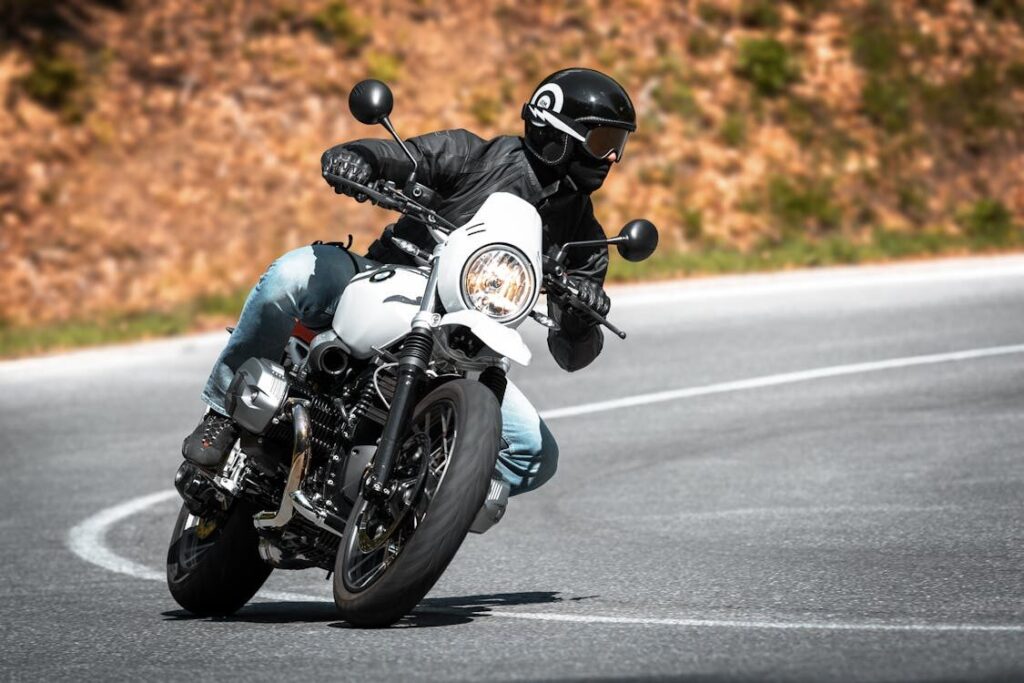
Anti-lock braking systems (ABS) prevent wheel lockup during emergency stops by rapidly modulating brake pressure — typically cycling 10-15 times per second. On motorcycles, this technology is particularly crucial because locked wheels can cause immediate loss of steering control. ABS systems specifically tuned for motorcycles account for weight transfer during braking and the different traction characteristics of front and rear wheels.
Modern stability control systems go beyond ABS to monitor lean angle, throttle position, and wheel speeds simultaneously. These systems can detect when rear wheel slip might develop into a slide and adjust power delivery accordingly. In dealing with the aftermath of serious collisions, motorcycle accident injury claims often involve complex questions about whether available safety technology was functioning properly — particularly when newer stability aids might have prevented or minimized the incident.
Traction control systems use similar sensor arrays to prevent excessive wheel spin during acceleration, especially critical when road conditions change unexpectedly. Unlike car-based traction control that can aggressively cut power, motorcycle systems are calibrated to maintain forward momentum while preventing dangerous slides. Many systems allow rider customization based on riding conditions and skill level.
Electronic suspension systems adjust damping rates in real-time based on road conditions and riding dynamics. While primarily comfort-focused, these systems also maintain optimal tire contact with the road surface, improving both handling predictability and maximum available traction for emergency maneuvers. The consistency of suspension response helps riders develop more accurate muscle memory for cornering and braking inputs.
Cornering ABS represents the latest evolution in motorcycle safety technology, maintaining braking effectiveness even when the motorcycle is leaned over in a turn. Traditional ABS systems can interfere with cornering dynamics, but newer systems calculate lean angle and adjust intervention thresholds accordingly. This allows riders to brake while cornering — a capability that can be crucial when obstacles appear mid-corner.
How Environmental and Situational Factors Affect Crash Risks
Road surface conditions affect motorcycles disproportionately compared to four-wheeled vehicles. A thin layer of moisture on asphalt — not enough to concern car drivers — can reduce motorcycle traction by up to 30%. This is why many motorcycle crashes occur during the first few minutes of light rain, before riders adjust their riding style to match available traction.
Lane splitting legality and safety data vary significantly by jurisdiction, but California’s controlled studies show specific patterns. Lane splitting at speeds more than 10 mph faster than surrounding traffic increases accident risk substantially, while splitting at similar speeds shows minimal risk increase. The critical factor is speed differential rather than absolute speed. Riders in areas where lane splitting isn’t legally recognized face different risk calculations, as other drivers don’t expect or accommodate the practice.
Construction zones present unique challenges because temporary traffic patterns disrupt the predictable behavior that defensive riding depends on. Concrete barriers create wind turbulence effects that can destabilize motorcycles, and temporary lane markings often provide poor visibility during rain. The combination of altered traffic flows and reduced visibility requires significant speed and following distance adjustments.
Temperature variations affect tire performance in ways that surprise many riders. Motorcycle tires require warm-up periods to reach optimal grip levels — cold tires can have 40% less traction than warmed ones. This is why many crashes occur during the first few miles of a ride, particularly on cool mornings when pavement temperatures are low.
Seasonal factors extend beyond weather to include changes in traffic patterns and driver behavior. Spring riding seasons often see increased accident rates as both riders and drivers readjust to sharing the road after winter breaks. Similarly, tourist areas during peak seasons present higher risks due to unfamiliar drivers and increased traffic density.
Understanding these environmental factors allows experienced riders to make informed decisions about when and where additional caution is warranted. The goal isn’t to avoid challenging conditions entirely, but to recognize when standard riding techniques need modification to maintain safety margins. Weather apps that include road surface temperature data and construction zone alerts are becoming valuable tools for route planning and risk assessment.