
People who enjoy riding usually care about more than speed. Speed has its appeal, but the real feel of a ride comes from smaller details: how smoothly it starts, how confidently it brakes, how clearly it turns, how the tires respond to the road, and whether the rider feels connected to the machine.
That is where many motorbike-minded riders can understand the appeal of an electric bike. It is not a replacement for a motorbike, and it does not need to be judged by the same standards. It is a lighter kind of ride: simpler, more flexible, easier to use for daily short trips, but still built around the feeling of choosing your route and controlling your own movement.
For riders who care about feel, that matters. Riding is not just getting from point A to point B. It is how you start, how you move through a turn, how you manage speed, how you read the surface, and how the bike responds to your body. Whether the machine is a motorcycle, an electric bicycle, or a more sport-inspired light electric ride, the conversation should not stop at specs. It should come back to control.
Riding Experience Is About More Than Speed
Speed is the easiest number to talk about, but it does not tell the whole story. Some bikes can go fast and still feel nervous. Others are not built around extreme speed, but they feel better day after day because the braking, posture, frame stability, and power delivery make sense.
In real riding, control comes from many details. Does the bike jump forward too sharply when you start? Does the frame feel steady in a turn? Do the tires give enough feedback on gravel, damp pavement, or rough patches? Does braking feel predictable, or does the bike make the rider tense?
Those details decide whether a bike only looks exciting or actually feels good to use often.
For light electric riding, this matters even more. These bikes often show up in short commutes, campus-area routes, neighborhood rides, weekend plans, trips to a court or field, or a quick coffee stop. In those settings, speed is not the main point. The real question is whether the rider can manage the bike comfortably and use it consistently.
A good daily electric ride should feel controlled instead of tense. It can have power and style, but the power should come in smoothly, and the style should sit on top of stability and safety.
Why Electric Bikes Appeal to Light-Ride Users
Electric bikes have gained attention because they fill a practical gap. Many short routes feel inconvenient by car, but a regular bicycle can feel like too much effort depending on the day, the weather, the route, or what the rider is carrying. Electric assistance creates another option between those two extremes.
The appeal is not only about the bike itself. It is about the whole experience feeling lighter. You can head out quickly, choose a flexible route, park more easily, and handle a short trip without turning it into a full physical challenge. At the same time, it still gives riders something that passive transportation does not: participation.
Electric assistance does not mean the rider stops being involved. You still need to watch the road, judge space, steer, brake, and understand your own speed. The motor support simply makes hills, wind, longer stretches, and repeated starts easier to handle. That can make riding a more realistic everyday choice.
This is where electric bikes overlap with motorbike culture in a useful way. Riders who understand motorcycles often understand feedback, road awareness, and responsibility. The pace of an electric bike may be lighter, but the need for control, gear, and safety awareness does not disappear.
Safety Awareness Through a Motorbike Mindset
Riders with motorbike experience usually understand one thing very well: a machine is not controlled by power alone. Real riding skill comes from vision, anticipation, braking, spacing, and reading the environment.
Light electric riding works the same way. Many risks come from not leaving enough room for decisions. Is there a blind spot at the intersection? Could a vehicle stop suddenly ahead? Could a pedestrian step out unexpectedly? Will a wet patch affect braking? Are you visible enough after dark? These questions matter more than simply asking how fast a bike can go.
Safety awareness does not make riding boring. It often makes riding smoother. When a rider knows when to slow down, when to look farther ahead, and when to leave extra braking space, the ride becomes more relaxed, not more restricted.
Basic gear also matters. A helmet, lights, reflective details, gloves, suitable shoes, and a reliable lock are all part of normal riding. The more often a bike becomes part of daily life, the less these basics should be treated as optional.
A Wheelie E Bike Should Bring the Conversation Back to Control
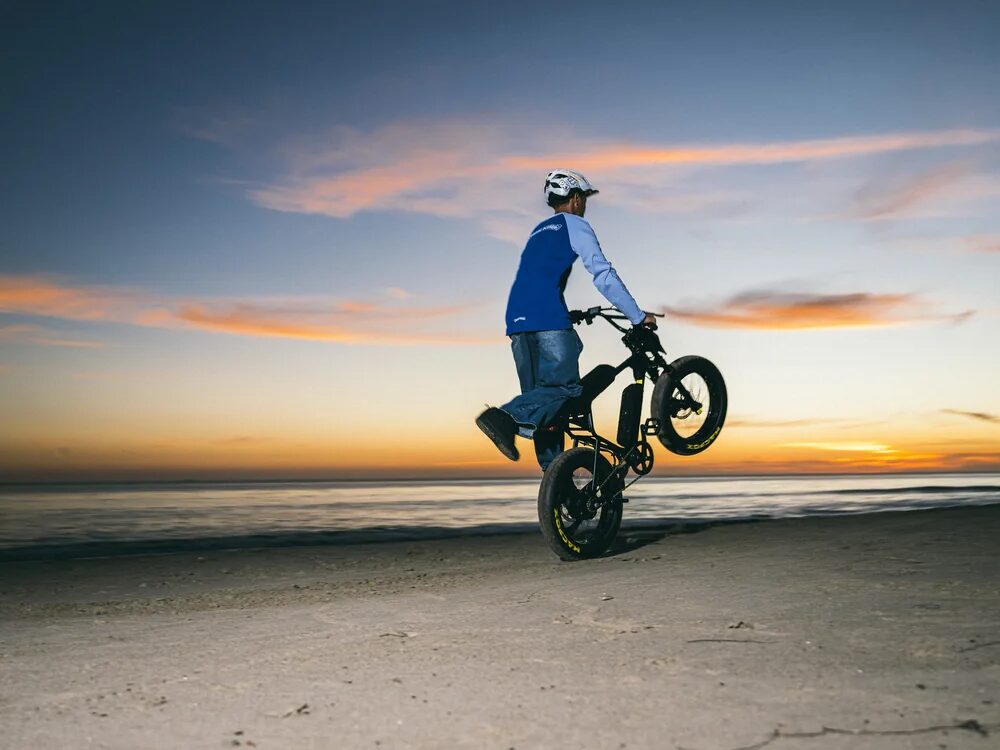
Some sportier electric ride styles attract riders who like quick response, strong visual presence, and a more street-inspired look. The phrase wheelie e bike is often connected with that kind of energy. But the more performance-oriented the style feels, the more important it is to bring the conversation back to control, not risky behavior.
A wheelie should not be attempted on public streets, bike lanes, sidewalks, parking areas with moving vehicles, or anywhere pedestrians are present. Public roads are not practice spaces. Traffic, surface changes, pedestrians, and unexpected situations cannot be fully controlled. Any front-wheel-lift practice belongs only in a closed, open, permitted safety area where no uninvolved people can enter.
Even in a suitable safety area, it should not be treated casually. Protective gear, available space, surface conditions, bike condition, brake response, nearby people, and local rules all matter. Experienced riders do not start by asking whether a move is possible. They first ask whether the environment allows it, whether they can control it, and whether there is enough margin if something goes wrong.
From that perspective, this category is better discussed as a matter of boundaries rather than instruction. It can reflect a sportier riding style and a rider’s interest in power response and bike control. But once safety areas, rules, and gear are ignored, the style loses its point.
Where Light Electric Riding Fits in Real Life
Light electric riding does not need extreme conditions to make sense. In many cases, its value appears in ordinary routes: a ride from home to school or work, a trip to meet friends, a stop at a gym, court, coffee shop, or store, a weekend ride across the neighborhood, or a quick errand that does not justify a heavier transportation choice.
These use cases do not need to be too narrowly defined. Daily riding is naturally flexible. One day the rider may be trying to save time. Another day, the goal may be to avoid sitting in a car for one more short trip. On the weekend, the ride may simply be a way to get outside for a while. The benefit of an electric bike is that it can adapt to that loose rhythm.
Compared with a regular bicycle, electric assistance is more forgiving when energy, weather, or distance changes. Compared with heavier motorized transportation, it feels more direct and easier to use for short local movement. It does not have to carry a big mission every time. If it makes a route feel more flexible and more controlled, it is already doing its job.
For people who like the feel of riding, that “daily ride with a little sport in it” can be the real appeal. The bike does not have to wait for one big weekend plan. It can become a natural part of the day.
What to Look for in an Electric Ride
If control is the starting point, choosing an electric bike should not come down only to power, top speed, or appearance. Those details can matter, but the more important question is how the bike feels in real use.
Frame stability comes first. If the bike feels loose or uncertain, turning and braking become less confident. Tires also matter because width, tread, and grip directly affect road feel. Brakes need to be reliable, especially on routes with intersections, slopes, stops, and changing conditions.
Power delivery should feel smooth. Acceleration that hits too suddenly can break the rider’s rhythm, especially at low speed, while turning, or in tighter areas. Good electric assistance should feel like support, not like the bike is pulling the rider along without permission.
Fit matters too. Riding position, handlebar height, pedal placement, and frame size all affect comfort and reaction time. A bike that feels comfortable is easier to ride often. A bike that feels natural is easier to control. Range should also match real routes, with enough margin for the way the bike will actually be used.
Style is part of the decision as well. Many riders care about how a bike looks and what it says about their taste. That is fair. Wanting to ride the bike is part of what makes it useful. But style should always sit on top of control, stability, and safe use.
The value of an electric bike is not that it replaces a motorbike or pushes everyone toward more speed. Its value is that it offers a lighter, more flexible, more everyday kind of ride. For people who genuinely enjoy riding, the most important thing is not how aggressive the bike looks. It is whether every ride gives them a clear sense of speed, space, route, and control.


