
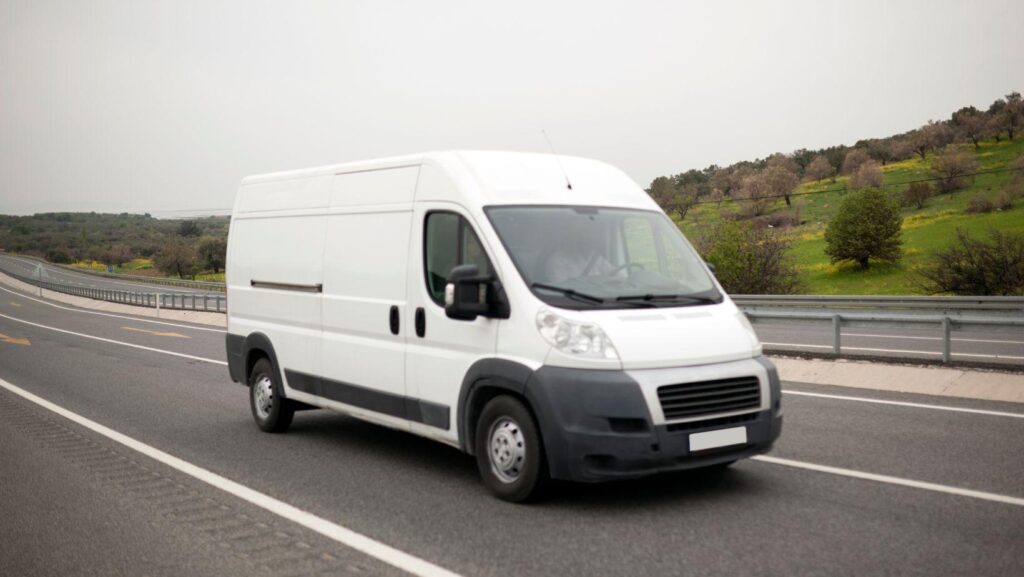
There’s a funny thing about commercial vans. Most reviews spend plenty of time talking about power, screens and how quickly they accelerate from the lights. Useful, sure. But if you actually work from a van, the questions are usually much less glamorous. Can you get a pallet through the back? Is the driver’s seat still comfortable at 4:30 in the afternoon? Can you reach your tools without climbing over half the cargo bay? That’s where something like the Farizon SV starts to make more sense, because it was designed as an electric commercial vehicle from the beginning rather than having an electric drivetrain squeezed into an older van platform.
Start at 6:30am, not in a showroom
Picture the usual morning.
Coffee in the cup holder. Phone connected. A few addresses already sitting in the navigation app and, somehow, somebody has parked across the workshop entrance again.
This is where the little details matter far more than they seem to on a test drive.
The SV cabin has physical climate controls rather than burying everything inside the central screen. There are also heated and ventilated seats for both front occupants. Neither sounds particularly exciting until you’re jumping in and out of the van all day.
Actually, scratch that. Ventilated seats during an Australian summer sound pretty exciting.
A commercial vehicle is effectively an office with wheels. If you’re spending six or eight hours inside it, comfort stops being a luxury pretty quickly.
Then comes the annoying part: loading it
This is where buying the wrong van gets expensive.
You don’t necessarily notice that you need another 300 mm of cargo length until you’re standing behind the vehicle with a ladder, shelving unit or awkward box that absolutely refuses to fit.
Farizon offers the SV in different body configurations, which is probably the more useful part of the story than any flashy technology. The short-wheelbase low-roof version offers 6.95 cubic metres of cargo volume and a payload capacity of 1,300 kg. The longer low-roof version increases cargo space to 8.25 cubic metres with a 1,235 kg payload rating.
Need height instead? The long-wheelbase high-roof model pushes cargo volume to 11.22 cubic metres. If the business needs even more room, the super-long-wheelbase high-roof increases cargo volume to 13 cubic metres while carrying up to 1,075 kg.
That choice matters because bigger isn’t automatically better.
A plumber working around inner Melbourne might prefer something shorter that’s easier to park. A furniture installer could happily trade some manoeuvrability for extra room. Courier fleets have another equation entirely.
So the sensible question isn’t, “Which one carries the most?”
It’s, “What am I actually putting in there every Tuesday?”
Midday is when range anxiety usually turns up
Electric commercial vehicles still trigger one predictable conversation.
“But what if the battery runs out?”
Fair question. Commercial vehicles aren’t Sunday toys. If the van isn’t moving, somebody is probably losing money.
The super-long-wheelbase model leads the range with a quoted WLTP figure of up to 398 km. The short-wheelbase version follows at 376 km, while the longer low-roof version is rated up to 355 km. Real driving range will naturally vary with payload, weather, driving style, terrain and battery condition, something Farizon itself points out.
And that distinction matters.
Nobody should look at a laboratory range figure, subtract their daily kilometres and assume everything will work perfectly forever. Leave yourself breathing room.
Instead, pull up a normal month of driving and look at what your vans actually do. If most days involve 120 km around Sydney with the vehicle returning to the same depot every night, the charging equation looks very different from a van doing unpredictable regional runs.
That’s the boring calculation worth doing.
There’s another electric van benefit hiding in the cargo bay
One feature you need to pay attention to, especially for trades, is vehicle-to-load capability.
V2L basically lets the vehicle battery supply electricity to external equipment. Farizon lists V2L capability among the SV’s features.
Think tools rather than tech jargon.
You arrive somewhere without convenient mains power and need to run equipment. Instead of immediately thinking about extension leads or a separate generator, the van itself can become part of the solution.
Not everybody needs that. A florist probably isn’t getting excited about powering tools from a van.
An electrician might.
By 5pm, running costs become more interesting than horsepower
This is the part private car buyers can sometimes ignore but businesses really can’t.
Purchase price is only one number.
Fuel or electricity, servicing, tyres, downtime and resale all sit behind it. Farizon says the purpose-built electric drivetrain uses fewer moving parts and is intended to reduce maintenance and per-kilometre running costs compared with conventional alternatives.
That doesn’t mean an EV automatically wins every financial comparison. Electricity prices differ. Charging infrastructure costs money. Some businesses rack up huge motorway distances while others barely leave a 20 km radius.
You have to run your own numbers.
But that’s also why electric vans are becoming harder to dismiss. For the right operation, especially one where vehicles return to a depot or home base overnight, charging can slot into the working day without requiring much behavioural change.
Plug in. Go home. Start again tomorrow.
Pretty simple.
The best test drive is probably your own working day
If you’re considering an electric commercial van, forget the scenic test route around the dealership.
Take measurements.
Write down your usual payload. Check your longest regular trip. Think about where the vehicle sleeps at night and whether charging there is realistic. Work out whether you need maximum cargo height or would rather have something easier to squeeze into a suburban parking space.
And sit in the driver’s seat for longer than 10 minutes.
Because after the novelty of an electric drivetrain wears off, a van still has one fairly unforgiving job.
It has to work.


