

Riding a motorcycle in Brisbane offers a sense of freedom that car drivers rarely experience. From the winding routes of Mount Nebo to the busy commute along the M1, motorbike riders are a staple of Queensland roads. However, this freedom comes with a significant trade-off: vulnerability. When a motorcycle collides with a passenger vehicle, the laws of physics are rarely in the rider’s favour.
The aftermath of a crash is often chaotic. You may be dealing with physical pain, a damaged bike, and the sudden inability to work. Amidst this confusion, navigating the legal landscape of a motorcycle accident claim can feel overwhelming. Yet, understanding your rights under Queensland law is vital. The compensation system exists to support your recovery, but strict time limits and procedural hurdles can derail a valid claim before it even begins. This guide is designed to demystify the process of claiming motorcycle accident compensation in Brisbane, explain the unique challenges riders face, and highlight the common legal mistakes that can jeopardise your future.
Overview of Motorcycle Accident Compensation in Brisbane
Motorcycle accidents are distinct from other road accidents due to the disproportionate severity of injuries sustained. While a “fender bender” between two cars might result in swapped insurance details and a minor inconvenience, a similar impact for a motorcyclist often leads to hospitalisation and life-altering consequences. Because the stakes are higher, the compensation claims process is more rigorous and requires a deeper understanding of the system.
In Queensland, the Compulsory Third Party (CTP) insurance scheme is the bedrock of motor vehicle accident compensation. This system is designed to provide financial support and cover medical costs for people injured on the roads. If you are hurt because of another driver’s negligence or even partial negligence you generally have a right to claim damages. This injury compensation is not a “payout” or a lottery win; its legal purpose is to restore you, as much as money can, to the position you were in before the motorbike accident occurred. It covers tangible losses like medical bills and lost wages, as well as the intangible impact of pain and suffering.
However, insurers are businesses with a primary goal of minimising claim payouts. Navigating this system without expert guidance can leave an injured rider at a significant disadvantage, potentially missing out on essential support for their recovery.
Key Challenges Motorcyclists Face After an Accident
Riders face systemic challenges that car drivers simply do not. The first hurdle is often a pervasive bias. There is an unfair “reckless rider” stereotype that can influence police reports, witness statements, and the initial assessment by an insurance adjuster. If a car turns across a rider’s path, the immediate assumption by some might be that the rider was speeding, even if they were travelling within the speed limit. A skilled right motorcycle accident lawyers in Brisbane is crucial for challenging and overcoming this prejudice with hard evidence.
Secondly, the nature of motorcycle accident injuries often leaves riders at an evidentiary disadvantage. In a collision, a car driver is likely to remain conscious and mobile, able to take photos of the accident scene, talk to witnesses, and provide their version of events to the police immediately. A motorcyclist, however, is often incapacitated by serious motorcycle injuries, such as fractures, road rash, or traumatic brain injuries, and is transported to the hospital before they can gather any evidence. This gap can lead to an incomplete or biased police report that becomes a significant hurdle later in the claim.
Understanding Liability and Fault in Motorcycle Accident Claims
Determining who is at fault is the cornerstone of any motorcycle accident claims in Queensland. Unlike some no-fault jurisdictions, Queensland’s CTP scheme generally requires you to prove that another party’s negligence was at least partially responsible for the accident to access the full range of common law damages.
However, fault is not always an all-or-nothing proposition. Queensland law recognises the concept of “contributory negligence.” This means that even if another driver clearly caused the crash, your actions could be seen as having contributed to the incident or the severity of your injuries. For a motorcyclist, this could involve:
- Lane filtering improperly or at an unsafe speed.
- Travelling slightly over the speed limit, even if the other driver ran a red light.
- Not wearing adequate protective gear or high-visibility clothing.
In these cases, your total compensation is reduced by a percentage that reflects your share of the responsibility. For example, if you are deemed 25% contributorily negligent, your final payout is reduced by 25%. Insurance companies often aggressively argue contributory negligence to minimize payouts, making it vital to have an experienced lawyer who can effectively counter these arguments.
Compulsory Third Party Insurance and Who Pays Compensation
A common misconception among riders is that making a claim means taking money directly from the other driver’s personal finances. This is almost never the case. In Queensland, compensation for personal injury is paid by the at-fault vehicle’s CTP insurer.
The Motor Accident Insurance Act 1994 (Qld) ensures that every registered vehicle in the state carries this mandatory CTP insurance. If you are injured in a crash with a car, their CTP insurer covers your injury claim. This creates a safety net, ensuring funds are available for your recovery without bankrupting an individual driver.
But what happens if the vehicle that hit you is unregistered, unidentified, or flees the scene in a hit-and-run? This is a frequent and terrifying scenario for riders. In these cases, your claim is made against the “Nominal Defendant.” This is a statutory body established under Queensland law that acts as the CTP insurer for at fault vehicles that cannot be identified or are uninsured. The process for claiming against the Nominal Defendant involves strict time limits and due diligence requirements, making prompt legal advice absolutely essential.
What Compensation Can You Claim After a Motorcycle Accident
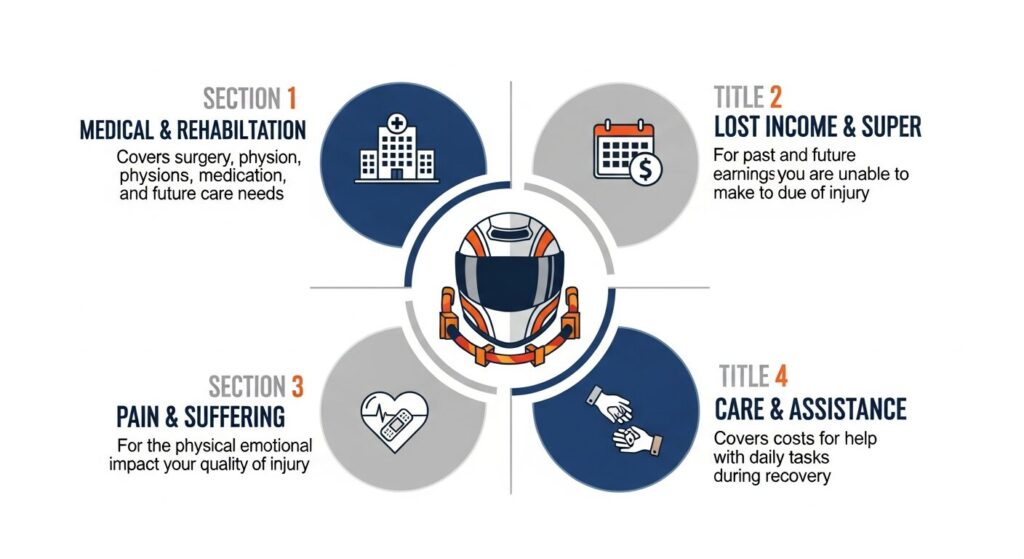
Compensation, legally referred to as “damages,” is calculated based on the specific impact the injury has on every aspect of your life. It is not a generic amount but a comprehensive assessment of your losses, both past and future. A successful damages claim typically covers several key areas:
- Medical Expenses and Rehabilitation: This includes all past costs such as ambulance transport, hospital stays, surgery, and medication. Crucially, it also provides for future needs, which could include ongoing physiotherapy, specialist consultations, home modifications, and psychological treatment.
- Economic Loss: This covers lost income from the time you were unable to work after the accident. More importantly, it includes “future economic loss” or loss of earning capacity. If your injuries prevent you from returning to your previous job or impact your career progression, this component compensates you for that lost future income stream.
- Pain and Suffering (General Damages): This compensates for the non-economic impact of your injuries—the physical pain, emotional distress, and loss of enjoyment of life. This amount is calculated using an “Injury Scale Value” (ISV) which assigns a numerical value to your injuries based on their severity and impact.
- Care and Assistance: If you require help from family, friends, or paid professionals for daily tasks like cleaning, cooking, or personal care during your recovery, you can claim compensation for the value of this assistance.
An experienced lawyer will ensure every one of these categories is thoroughly investigated and claimed to secure your financial future.
Common Legal Mistakes Motorcycle Riders Make
The period immediately following an accident is stressful, and unfortunately, this is when many riders inadvertently damage their own claims. Avoiding these common pitfalls is essential for protecting your rights.
- Failing to Seek Immediate Medical Attention: Adrenaline is a powerful pain masker. Many riders walk away from a crash feeling “bruised but okay,” only to wake up the next day with severe injuries. If you do not see a doctor immediately, the insurance company may argue that your injuries were not serious or occurred after the accident. A continuous medical record starting from the day of the crash is your strongest evidence.
- Admitting Fault at the Scene: It is human nature to apologise, even when you aren’t wrong. Saying “I’m sorry” or “I didn’t see you” can be interpreted as an admission of guilt and used against you by the CTP insurer. Stick to the facts only.
- Giving a Detailed Statement to the Other Driver’s Insurer: The at-fault driver’s insurer will likely call you seeking a statement. Their goal is to obtain information that minimises their liability. You are not obligated to provide one. Politely decline and seek legal advice first.
- Not Documenting Everything: Your memory will fade. Keep a detailed diary of your pain levels, medical appointments, and how the injuries impact your daily life. Keep receipts for all out-of-pocket expenses, including medication, travel to doctors, and paid help.
- Missing Strict Time Limits: Queensland law has rigid deadlines. You must generally lodge a claim form within nine months of the accident (or from when symptoms first appear). If the at-fault vehicle is unidentified, this timeframe can be even shorter. Missing a deadline can extinguish your right to claim forever.
- Posting on Social Media: Insurers regularly investigate claimants’ social media profiles. A photo of you at a BBQ, even if you are in pain, can be taken out of context and used to argue that your injuries are not as severe as you claim. It is best to stay off social media entirely while your claim is active.
Steps to Take Immediately After a Motorcycle Accident in Brisbane
Taking the right steps in the minutes and days after a crash can significantly influence the success of your recovery and your potential claim.
- Ensure Safety First: If you can, move off the road to a safe location. Call 000 immediately if anyone is injured or if the road is blocked.
- Gather Evidence at the Scene: If you are physically able, use your phone to take extensive photos and videos. Document the position of the vehicles, skid marks, debris on the road, your damaged bike, your injuries, and any relevant road conditions like potholes, loose gravel from road works, or obscured signage.
- Identify Witnesses: Independent witness statements are incredibly valuable. Get the names and phone numbers of anyone who saw the crash. Do not rely on the police to collect these details for you.
- Exchange Details: Obtain the name, address, phone number, vehicle registration, and insurance details of all other drivers involved. If they refuse or flee the scene, immediately write down their license plate number and a description of the car and driver.
- Report to Police: All road accidents involving injury must be reported to the police. An official police report is a key document in your claim.
- Seek Medical Attention: Go to a GP or hospital emergency department as soon as possible, even for what seem like minor bumps or scrapes. Tell the doctor exactly how the accident happened and report every single area of pain, no matter how minor it seems. This creates a crucial medical record linking your injuries to the accident.
Why Experienced Motorcycle Accident Lawyers Matter
Attempting to navigate a motorbike accident claim alone pits you directly against a well-resourced insurance company whose employees are trained to resolve claims for the lowest possible amount. Motorcycle accident lawyers are specialists who level the playing field.
An expert personal injury lawyer provides critical legal advice and serves as a buffer between you and the insurer. While you focus on your physical recovery, your lawyer focuses on:
- Building a Robust Case: They gather all necessary evidence, including police reports, witness statements, CCTV footage, and expert reports from accident reconstruction engineers or medical specialists.
- Calculating Your Full Damages: They have the experience to accurately assess the long-term financial impact of your injuries, ensuring no future cost is overlooked.
- Negotiating Effectively: They understand the tactics insurers use to downplay injuries or allege contributory negligence and know how to counter them with strong legal arguments and evidence.
- Managing the Legal Process: They ensure all deadlines are met and all complex legal paperwork is handled correctly, protecting you from procedural errors that could derail your claim.
Furthermore, most reputable accident lawyers and personal injury law firms operate on a No Win No Fee basis. This means you do not have to pay for legal fees unless your claim is successful, removing financial barriers to accessing expert legal representation when you need it most.
Summary
Recovering from a motorcycle accident is a physical, emotional, and financial marathon. While the road to recovery can be long, understanding your legal rights under Queensland’s CTP scheme is the first step toward securing your future. By avoiding common mistakes like delaying medical treatment or speaking to insurers without representation, and by taking proactive steps to protect your claim from the very beginning, you can secure the compensation necessary to rebuild your life. The law is there to protect you, but it requires you to act wisely and seek expert support.
Frequently Asked Questions
1: How much compensation can you get for a motorcycle accident in Brisbane?
There is no fixed payout amount for a motorcycle accident claim in Brisbane. Compensation is calculated based on the specific impact the accident has had on your life. Key factors include the severity of your injuries (assessed under an Injury Scale Value), the total cost of past and future medical expenses and rehabilitation, and the amount of income you have lost and will lose in the future due to your injuries. Payments also cover pain and suffering and any paid or unpaid care you require. Because every rider’s employment, age, and injury recovery are different, compensation varies significantly from case to case.
FAQ 2: What is the hardest injury to prove in a motorcycle accident claim?
Psychological injuries, such as Post-Traumatic Stress Disorder (PTSD), anxiety, and depression, are often the most difficult to prove. Unlike broken bones which show up clearly on X-rays, mental health conditions rely on subjective reporting and a consistent medical history. To successfully claim for these, you need strong supporting evidence from psychiatrists or psychologists and a documented history of treatment. Additionally, chronic pain and soft tissue injuries can be disputed by insurers if there is a delay in seeking medical treatment or gaps in your medical records, making immediate and consistent medical care vital.
FAQ 3: What percentage of motorcycle accidents are caused by rider error?
While statistics vary, it is a common misconception that riders are automatically at fault. Research from transport authorities, including a comprehensive study in Victoria, has shown that in multi-vehicle collisions, the other driver is at fault in the majority of cases, often due to failing to see the rider or violating their right-of-way. However, Queensland law considers “contributory negligence.” This means that even if a rider didn’t cause the crash, their actions (like speeding or improper gear) might be found to have contributed to the severity of the injury. Fault is determined on the specific facts of each accident, not general statistics.
FAQ 4: Can I make a motorcycle accident compensation claim if I was partly at fault?
Yes, you can often still claim compensation even if you were partly to blame. Queensland operates under the principle of contributory negligence. If a court or insurer determines you were partially responsible (for example, 20% at fault for speeding), your compensation payout will simply be reduced by that percentage. You would still receive the remaining 80% of the assessed damages. It is rare for a claim to be completely blocked unless the rider was 100% at fault for the incident.
FAQ 5: What is a common law claim for psychological injury in Queensland?
A common law claim is the process of seeking damages (compensation) from an at-fault party’s insurer for negligence. For a psychological injury like PTSD or severe depression resulting from a crash, you are eligible to make a claim if you can prove the accident caused the condition and it has had a significant impact on your life. These claims are complex and require substantial evidence from medical experts, such as a psychiatrist, who can connect the mental trauma directly to the accident. A successful claim can cover the cost of therapy, medication, and loss of income caused by the psychological injury.
FAQ 6: How long does a motorcycle accident compensation claim take in Queensland?
The timeline for a claim varies widely, typically taking anywhere from 12 months to over two years to finalise. The duration depends heavily on how long it takes for your injuries to stabilise; medical experts cannot provide a final assessment of permanent impairment until you have reached “maximum medical improvement.” Delays can also occur if liability is disputed by the insurer or if the case involves complex negotiations. Engaging a lawyer early can help streamline the process, but the medical recovery journey is the primary factor influencing the timeline.
FAQ 7: What mistakes can reduce motorcycle accident compensation?
Several common errors can negatively impact your payout. The most damaging is failing to seek immediate and consistent medical attention, which gives insurers a chance to argue the injuries weren’t caused by the crash or aren’t as severe as claimed. Other critical mistakes include admitting any degree of fault at the scene, posting about the accident or your recovery on social media, failing to report the crash to the police, and missing the strict legislative time limits for lodging your claim forms. Proper legal advice can help you avoid these costly pitfalls.


